
Passionate. Since 1953
The story of Bastei Lübbe. In five stories.
The story of Bastei Lübbe. In five stories.
In the postwar years, Gustav Lübbe was working as editor of the culture section of a newspaper in Osnabrück. In 1950 he followed a gut feeling and bought shares in a small publishing company based in Cologne. Bastei Verlag, named after the battlements of a fortification overlooking Cologne Harbour, published so-called ‘dime novels’, which were very popular with the public at the time. Lübbe was fascinated by the success of these pulp novels, but initially kept his ideas to himself. Unfortunately, the company – run at that point by its founder Ilse Tormin – began to struggle, and in 1953 an already difficult situation became even more critical. Bastei Verlag was on the verge of bankruptcy.
Gustav Lübbe consulted his wife Ursula, whom he had married in 1949 and who would be his most important advisor for decades to come. She would also play a vital role in shaping the future publishing group. They faced a difficult decision: should they cut their losses or take over Bastei Verlag completely? The couple decided to be bold. But they still had a long way to go before the company would become one of Germany’s biggest publishers. The young couple moved to Bergisch Gladbach, where they ran the company out of a garage with no windows. The next steps were not easy, but at last the gut feeling that had guided Gustav Lübbe’s decisions in those early days was borne out. 1954 saw the first appearance of ‘Jerry Cotton’, the hero of a series of crime novels and the first in a long line of successes for Bastei Lübbe, which is now one of the biggest publishing groups in Germany.
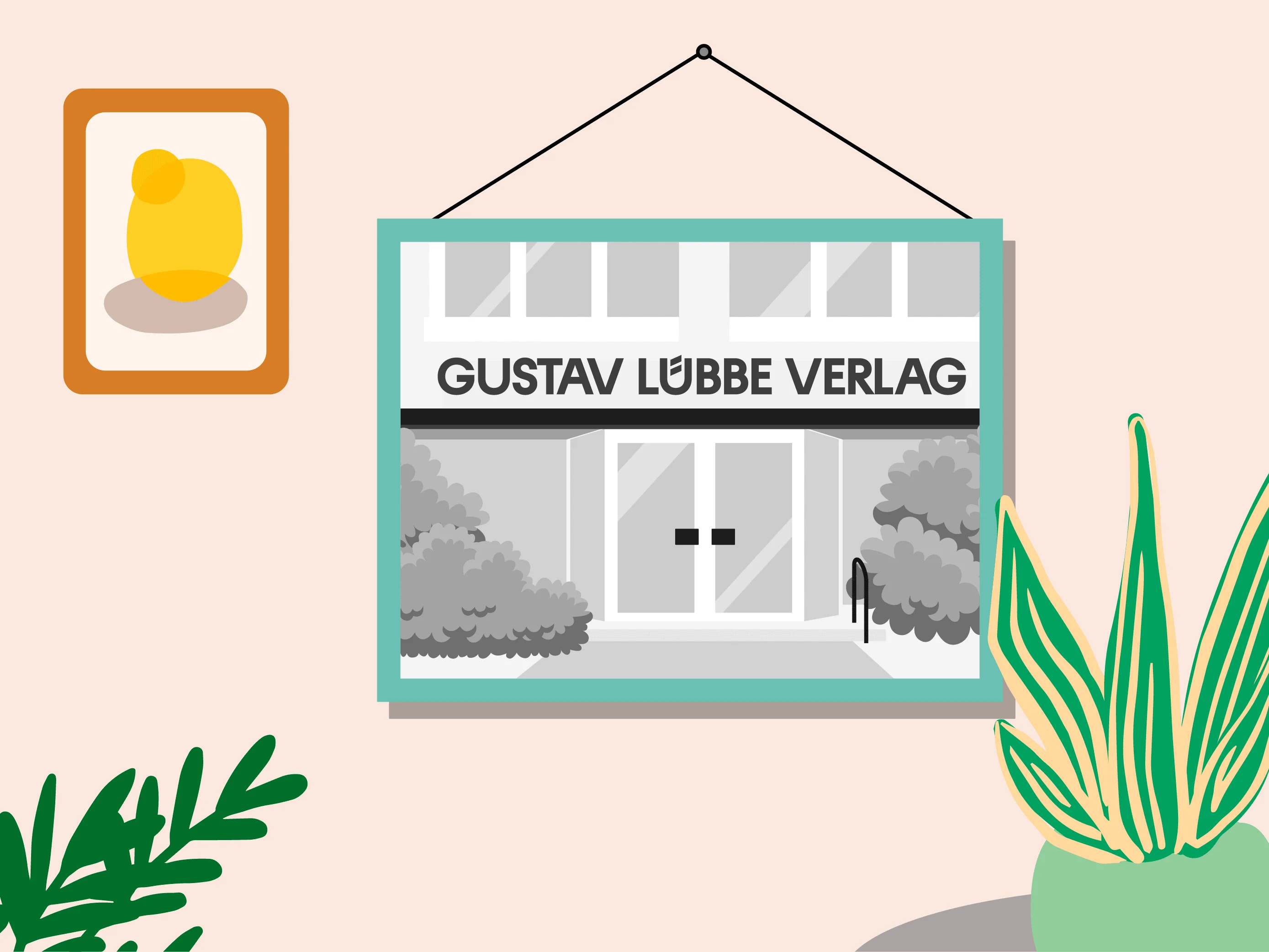
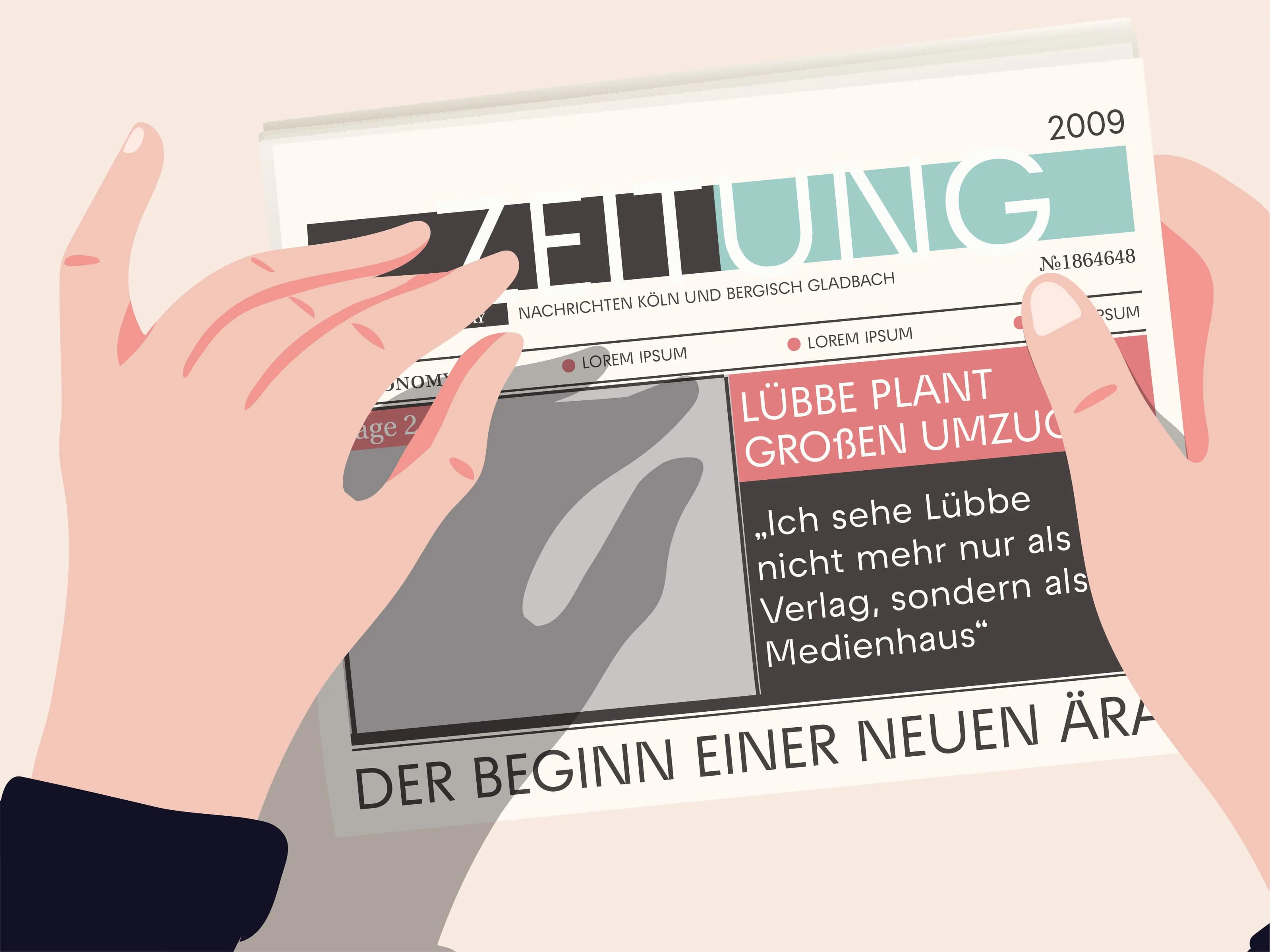
Since 1956, so since its earliest days, the “Verlagsgruppe Lübbe GmbH & Co. KG” (to give the company its full name) had remained loyal to Bergisch Gladbach, where it was based on the Zinkhütte industrial estate. But there had been speculation for some time about a potential move, and the local paper, the Kölnische Rundschau, had been alluding to it for months. At last, at the end of the year, this speculation was confirmed. The company was to relocate to new premises in Cologne, in the “Carlswerk”, an up-and-coming industrial complex in Cologne-Mülheim. It would occupy 6,000 square metres in the old administrative building of the cable manufacturer Felten und Guillaume – a very generous space in comparison to the company's previous headquarters. At the time, Stefan Lübbe made clear in an interview with the Börsenblatt that it was not only the company's address that was about to change, but also the way it defined itself. “I no longer see Lübbe solely as a publisher, but as a media company,” he said, adding: “Just producing books is not enough.” This was also the rationale behind the company's name change – from then on it was called “Bastei Lübbe GmbH & Co KG”. The company's transformation into a diversified media company is now complete, of course, and we’re told that our headquarters in Cologne-Mülheim are appreciated by partners, authors and employees alike.
For Stefan Lübbe – who in 2013 was the director of Bastei Lübbe as well as its chief representative and principal owner – the day of the initial public offering of this company that his parents had founded sixty years earlier was not without risk. The company had just been transformed from a publishing house into a multidimensional media company, and was keen to secure new capital for potential further expansion. Lübbe was well aware, however, that this was a “moment of truth”. Despite meticulous preparations and a very positive response to the company’s “road show” in various European capitals, nobody could predict what value investors would assign to the stock which from now on would be listed in the Prime Standard segment of the Frankfurt Stock Exchange. How much appeal can a company hold for investors when its main sphere of business is the book market – which is supposedly in crisis? How plausible is the company’s optimistic outlook in the context of the apparent threat from digitalisation? The initial public offering in 2013 brought in 30 million euros in capital. Now, twelve years later, Bastei Lübbe AG is an established name among Germany’s medium-sized listed companies. The strategic decisions taken over the past five years in particular have led to a significant increase in the company's share price. Above all, however, the company has delivered on the fundamental promise Stefan Lübbe made when he entered the trading floor back in 2013: that a publishing group in an environment dominated by technology can be progressive and an appealing prospect for investors.

With some books, it’s clear even before publication that they are very likely to become bestsellers. The release date of books like Dan Brown’s The Secret of Secrets is a global event involving months of meticulous planning in many countries. Everything follows a precise script. But success is only partly down to professional marketing; it’s as if not more important to provide a home for authors who are already big names. Bastei Lübbe has decades of experience in looking after such authors – from established names like Ken Follett and Jeff Kinney to younger bestselling authors like Mona Kasten and Rebecca Gablé. Trust is at the heart of everything. We are familiar with our authors’ preferences when it comes to their day-to-day work, and with their specific needs when it comes to translation, marketing, book tours etc. We understand these authors as brands, and we play our part in making these brands popular with readers. Ultimately, it’s hard to say what a “home” means to a bestselling author. Perhaps it’s a moment like the one we experienced recently, sitting on two rustic wooden benches in the Bavarian Alps at an altitude of 1600 metres. We and some publisher colleagues were sitting with Jeff Kinney discussing a project that was to build on the success of Diary of a Wimpy Kid. Until suddenly he exclaimed: “Any chance of getting a beer around here?”

The book trade functions according to certain rules – target audiences are categorised, genres neatly separated. Real surprises don’t come around very often. Looking back, it’s not entirely clear exactly how “New Adult” became an industry phenomenon. Some say it was to do with the Covid pandemic and the way it caused people to turn in upon themselves. But what we can say for certain is that an entire generation of (mainly) girls and young women are now hooked on reading. In a diverse range of stories across many different genres, New Adult books explore the feeling and experience of being ‘not quite an adult yet’. Bastei Lübbe spotted the trend early and set up its own imprint, LYX. LYX publishes the Maxton Hall series by Mona Kasten, a New Adult bestseller which has since been turned into a TV series and enjoyed international success on Amazon Prime. A cross-platform media presence is an absolute must. LYX has over 19,000 followers on Instagram alone (as of September 2025) and in 2024 the imprint organised the first ‘LYX Festival’, which was held at the Gürzenich Festival Hall in Cologne and attracted over 4,000 New Adult fans. At the event, readers got to meet their authors in person. It was almost as if we had come full circle.